

Case Study: A Community Building Its Own Water Security
Article contributed by David Venhuizen and Christy Langendoen
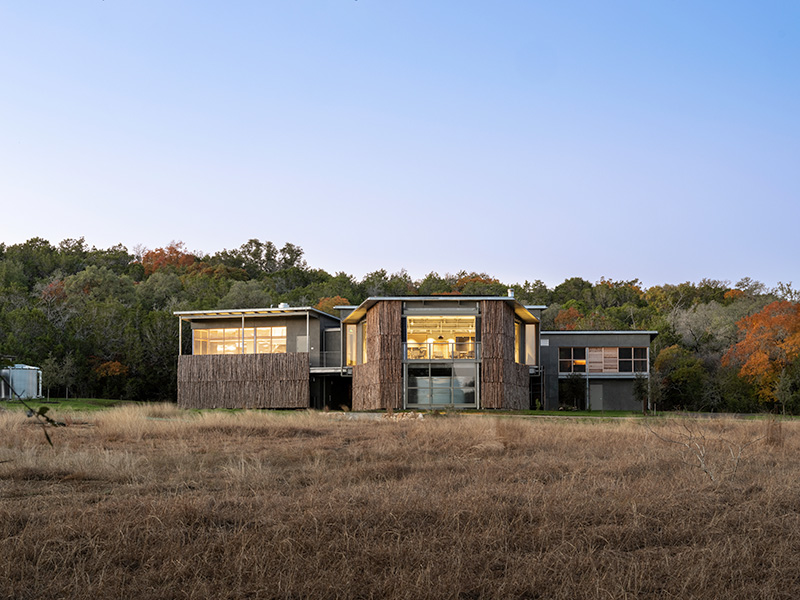
The Campsite at Shield Ranch Rainwater Harvesting (RWH) system was the first building-scale rainwater supply in Texas permitted as a Public Water Supply System (PWSS). Achieving this required extensive coordination with the Texas Commission on Environmental Quality (TCEQ), including submitting exception requests for non-standard storage tanks and a cartridge filter treatment unit, designing a customized treatment train, and engineering the water pressurization and distribution systems.
Building-scale RWH was determined to be the only reasonable water supply option for the Campsite. No public water lines exist in the area, and local aquifers are in decline. As a result, the system needed to be sized to either fully meet projected demand or define realistic limits on usage. A modeling tool developed by the author, using rainfall data from 2007–2017, was used for this analysis. The planned facilities provided 7,340 square feet of harvestable roof area, and average daily water demands were estimated for each month.
The rainwater is stored in two 30,500-gallon reservoirs and two 3,400-gallon cisterns, equaling a combined storage capacity of 67,800 gallons. One of the 3,400-gallon cisterns stores treated rainwater while the other stores raw rainwater.
Modeling showed that with 67,800 gallons of storage, the system would satisfy demand in all but the most severe drought years, meeting approximately 99 percent of total water use over the 11-year period. These results formed the basis for system design.
Under TCEQ rules, the galvanized steel tanks with flexible liners used for both raw and treated water storage required exceptions, as they are not covered by American Water Works Association (AWWA) standards. Approval required detailed documentation of tank materials, design features, and appurtenances such as access hatches, ladders, level indicators, and inlet and outlet ports.
The cartridge filter treatment unit also required an exception due to the lack of an applicable AWWA standard. Two cartridge filtration systems—manufactured by Graver and Harmsco—had previously undergone TCEQ-recognized challenge testing to demonstrate required pathogen removal. The Harmsco unit was selected for this project, with approval based largely on its challenge-testing certification.
The completed system includes duplex raw-water pumps and controls; a treatment train consisting of three pre-filters (100-, 20-, and 1-micron) followed by a 1-micron Harmsco filter; chlorine injection for disinfection; treated-water storage; duplex service pumps, pressure tanks, and controls; turbidity monitoring upstream and downstream of treatment; a recovery system to return monitoring flows to the raw cistern; and a distribution network serving the main building, shower building, and four outbuildings with handwashing sinks.
The Campsite at Shield Ranch, located in the Barton Creek watershed, provides an immersive nature experience through a facility designed to operate 100 percent off grid. Electricity is supplied by solar panels, and water is provided by a building-scale rainwater harvesting system. Because water use at the Campsite exceeds the threshold established by TCEQ for classification as a Public Water Supply System, the RWH system was required to be permitted as a PWSS in order to legally supply potable water.